Thursday, March 22, 2012

Some Thoughts on Consciousness


Tomorrow I'll be co-presenting a talk on consciousness to the Philosophy Club at Texas A&M. This is a rich subject, with thousands of years of argumentation on just about every side imaginable. To say that consciousness is poorly understood would be a bit of an understatement. I'm not an expert in philosophy, neuroscience, or metaphysics, so my opinions and their divergences from mainstream theories of consciousness aren't of any great import. In my mind, though, this is one of the most interesting subjects to examine, and I can't help but try to synthesize something out of the mountains of thoughts that have been composed over the years. In my introduction, I plan to say something along these lines:

"Consciousness is that aspect of your mind that’s left undescribed when you say your brain is like a computer. It’s the inner world of color and sound, of pain and euphoria, of presence and awareness, that exists for you alone. Like a machine intelligence we sense, remember, and act, but more than that, we perceive, believe, and yearn, and that explosive wondrous world that it is to be human is what consciousness is. Reconciling the dazzling warm world of sensation with the cold dispassionate world of material things around us is the challenge of understanding what consciousness is."

In an unrelated issue, I should probably post pictures of something other than sunsets at some point.

Tuesday, February 21, 2012

Litany for a Psychedelic Sunset


This evening I watched a very pretty sunset from Research Park, just east of Easterwood Airport. The clouds were low and moved briskly as their color wandered from gray to orange to pink. To the west, the airplanes wandered down to Earth, whistling in the wind shear. This all, unfortunately, has nothing to do with pictured sunset (an October one in Boulder, Colorado), as the fact that my phone is also a camera completely slipped my mind.

Watching the shapes and colors this evening, some words came to mind, mostly on the simple wonder of being there that moment. It was something of a litany, for a sight that manifests in the soul as much as in the eyes.


I will open my eyes,
and see all that is.
I will open my mind,
and know all that is.
I will open my heart,
and accept all that is.
I will open my soul,
and be all that is.
I will see the melody.
I will hear the sunshine.
I will welcome the world into me,
and when she has passed,
I will know only these:
Beauty, wonder, joy, awe,
and love beyond all else.
I will reach out,
and my love will make the world shine.
I will breathe.
I will breathe.
I will breathe.
I will be.

Tonight, look west when the sun sets. You'll like what you see, I think.


Friday, January 6, 2012

How Winglets Work


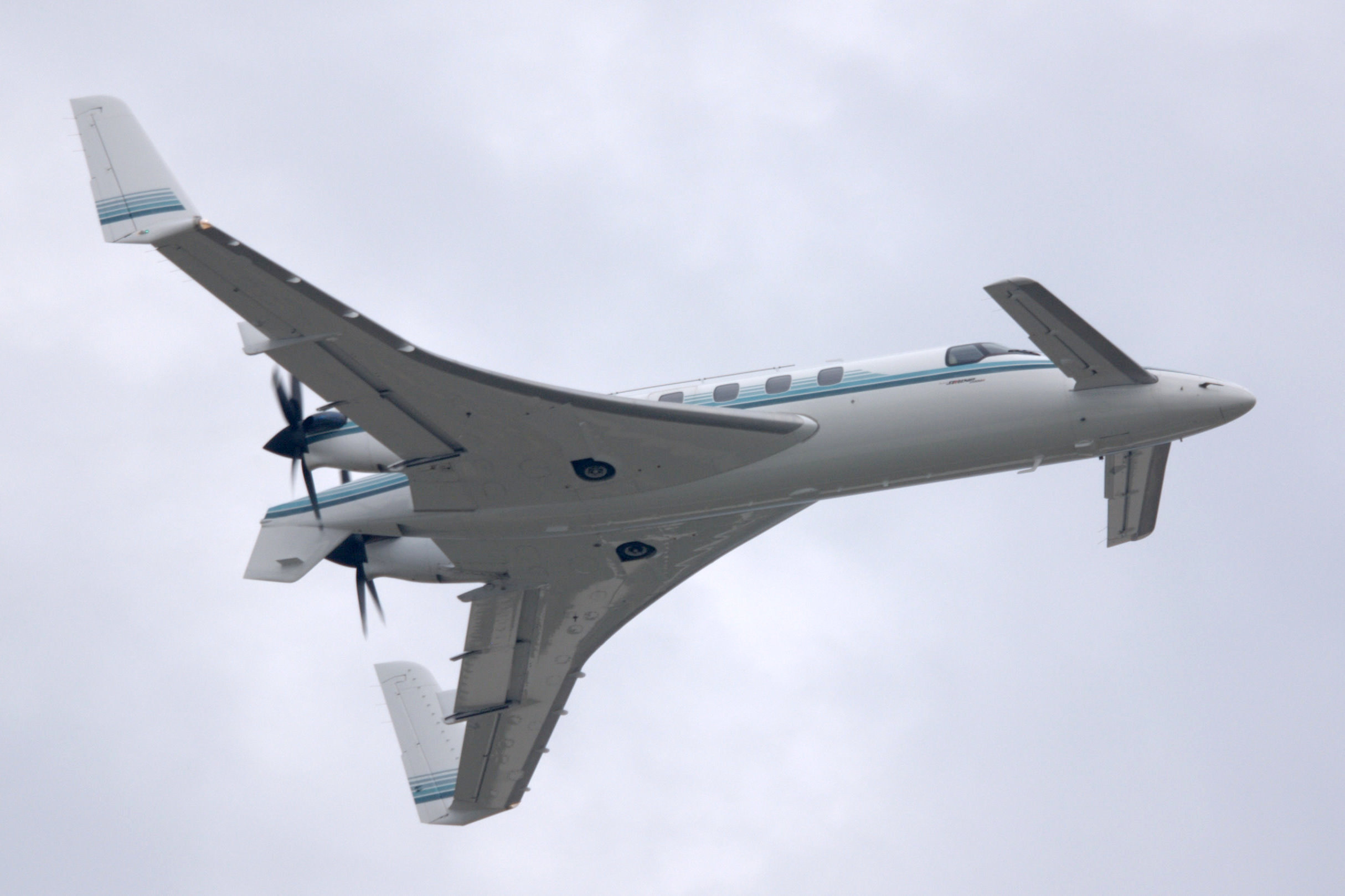
A friend of mine asked why some airplanes have winglets yesterday. The Wikipedia article has a fine explanation, but I thought I'd try my hand at explaining a part of my field you're more likely to encounter in your daily life than, say, bell nozzles.


The wing's main purpose in life is to produce a pressure difference between the top and bottom surfaces. The contours of the wing force air to accelerate over the top surface, dropping pressure relative to the bottom, and providing a net upward force on the airplane, allowing it to fly.


At the wingtips, though, this pressure difference can't be maintained. High-pressure air on the bottom spills over to the top surface, swirling around in a horizontal vortex at each wingtip. The vortex influences the air travelling over to the wing, pushing it down, making the wing feel like it's canted downward into the oncoming flow. Since wings produce more lift the higher they're angled into the oncoming airflow, this reduces the lift on the wing, while the friction drag of air grinding over the wing remains the same. To cruise the farthest while burning the least fuel, maximizing the amount of lift per unit drag is crucial, and any innovation that can improve wing lift without increasing drag is one of the sweetest prizes an airplane designer can win.


Suppose that the tip of the wing curved up for the last few feet instead. There would still be some pressure difference between the outboard and inboard sides of the wingtip (or winglet), but since the vertical section itself isn't producing lift, it would be less than in the winglet-free case. Wingtip vorticies are less intense and further away from the main, lifting, section of the wing when winglets are present, boosting wing lift and allowing an airplane to carry more payload further for the same size wings.


To pay for this cruise lift-to-drag coup, the airplane now has to carry two surfaces that weigh something and add some skin friction drag. The optimum size winglet is that which properly balances the drag reduction from moving tip vorticies away from the wings with the drag increase from the extra surface area and the fuel penalty of lugging an extra few pounds to cruise altitude. For small, short range aircraft, the optimum winglet might be none at all, though the Rutan Long-EZ proved the concept on a small scale in the early 1980s. Typically, the longer the airplane's mission, the more sense winglets make.


It's hard to comprehend the violence of what air can do at high speeds, given how docile it is in our everyday experiences. Even at "low" speed, while descending to land, air hits the wings, tail, and fuselage with the force of a hurricane. The next time you're flying to or from a humid place in the summer (say, Houston or Orlando), take a look at the wing on your way up or down. Vortices at the tips and gaps in the wings churn the air so hard the water condenses into a wispy filament of cloud, a tornado's funnel cloud in miniature, but with the majesty preserved. That's the airplane, holding you and a hundred strangers high above where you began. It's an impressive sight.

Saturday, December 31, 2011

The Year of Humility


Most places around the world, 2011 is complete. The year has a few hours of life left here, and a few more in Hawaii, and then 2012 will shift from the future to the present.

The previous year was pre-selected for some major events in my life. I finished college, and began grad school. I knew these milestones would be passed this year some time ago, and looked forward to 2011 with a hopeful kind of impatience. I picked up an award, a diploma, a few fellowships, and a job offer at Boeing, and left for a summer in Seattle for the second time in my life.

2011 was trying in a host of ways I didn't, and probably couldn't have, anticipated. Finishing college forced me to come face to face with the wideness of the gulf between the shifts I want to effect in the world and the tools I have to accomplish things right now. The constant, gypsy-like motion of living my life in 16 week increments is starting to get old. Most of all, grad school itself has been trying beyond anything I would've believed before this August. I feel battered and weary after a semester striving to warp myself into some creature that can thrive in this climate, and realizing that I don't really want to do that. More on this later.

More than most years, it seems like the world's a bit emptier than when the year began. In 2011 we said goodbye to people evil (bin Laden, Gaddafi, Kim), visionary and creative (Jobs, Hitchens, Havel), and personal (my grandpa, Obbie). The three surviving Space Shuttle orbiters lie still, never again to fly under power. Juno and Curiosity have left Earth forever, bound for Jupiter and Mars. Earth now holds seven billion people, and space six, all better fed than ever before. The gains of this year are sure to exceed the losses, but that will take time to realize.

More than anything, I feel humbled at the end of this year. I've reached all my life, and after the last semester I'm sorer than usual from reaching. For all the ends and codas and completed programs of the past year, the world remains incomplete, to say the least. There's nothing special about the particular year of 2012. Even its boundaries are arbitrary constructs. It's simply next. The next place we act, the next time with which to yearn and act and decide. As the year closes, I think A. E. Housman's sentiment in "Reveille" is appropriate:

Clay lies still, but blood's a rover;
Breath's a ware that will not keep.
Up, lad; when the journey's over
There'll be time enough for sleep.

Monday, December 5, 2011

On Kneeling in Doubt


Earlier today I spent about nine hours working on a problem set for my dynamics class. That in itself isn't too bad, or too strenuous, but given that today has been a more relaxed day than most for classwork and the end of the semester is fast approaching, I'm not really at my best right now in terms of rest or responsiveness. When I left midway through deriving the Lagrangian equations of motion for a double pendulum (because I'm cool and do that kind of thing in grad school) to head to the evening mass at St. Mary's, Zach asked the obvious. Was I Catholic? I said "no," which is true, and brushed off the question of why I would do such a thing since I didn't have a good response.

It bothers me that I don't have a good response to this. When Augustine was going through RCIA last year, we talked often about Catholic whatnot and I was generally intrigued by her insight. Now that she's out of College Station, the only thing keeping up my momentum to learn more about religion and general and Catholic-flavored Christianity in particular is my own stubbornness, and I'm starting to realize the limits of that drive. Stubbornness is good for keeping up a mindless plod forward, but is quite weak in the face of the complexities and mysteries of life and religion. I keep sitting and genuflecting and kneeling in church, but less often than I used to. Those equations aren't going to derive themselves, after all, and in the meantime the question of why I should be there when I don't share the creed haunts me.

I'm tired of feeling out of place at St. Mary's. I'm tired of standing silently, like an idiot, while everyone else gets on with the Nicene Creed. I'm tired of feeling like a clockwork Christian, doing the motions, understanding the arguments, even feeling the right emotions at the right times, and not having a damn clue if any of it means anything at all. The reality is that I understand Christian theology and arguments better now than I have at any point in my life before, and I still don't find it convincing, on balance. Catholicism is a beautiful idea, but for all my effort to unstick my paradigm and see if it'll shift, I can't see it as anything but an idea. It makes zero sense to continue acting as though I were Catholic, a part of my mind concludes.

Yet I find something compelling, something alluring about this faith. Faith itself is something so exotic and incomprehensible to the workings of my mind that I can't help but find some allure anywhere in organized religion I look, I suppose. Maybe it's just an effect of the soft blue walls and the pretty Catholic choir girls, but I feel a sense of calm kneeling among the faithful. It's not clarity, which I'd like, but even among the murk something just feels right about being there. I feel stupid during the creed, but then we sit down and sing "Hosanna," and I don't care about feeling stupid anymore, it just feels nice. So I go back, wondering what I'm doing or where I'm going, but in the pews for now.

I can't imagine anyone, atheist or faithful, would look on this story with anything but pity. Listening to many, it sounds as though it should be obvious one way or the other, and only a poor pitiful fool would hem and haw the way I've been doing for over a year now. I'm so sick and tired of being something to pity. I wish that I could shelve everything academic and focus all the solution techniques I've learned in engineering school on this one single issue. Are the Christians right? This question lingers long after I grow weary of the endless dynamics and continuum mechanics problems.

With the crunch of finals bearing down I don't expect to post again until after December 14. My experience in grad school so far merits discussion of its own, but for now I'll just mention that I'm dissatisfied enough with the environment to be looking elsewhere. I've applied for a job in Washington, DC, and I rolled the thought over and over in my head after receiving my blessing, Should I go east, if they want me? Once communion was done and we sat back in the pews, we sang the closing hymn, "People, Look East."

I'm not superstitious, but sometimes I wish I was. It would make major life decisions so much easier.

Saturday, November 26, 2011

The Conception of Curiosity


I saw a spaceship go to Mars today. It was very exciting.

Like a sunset or a southwest canyon, a rocket in launch is not something that can be captured losslessly in photographs or video. Images can convey something of the events that occur, but the richness of the time and place is muted relative to truly witnessing the launch. You really need to go see something like this for yourself, but maybe my words can add something to the many pictures and videos you can find. Watching the Atlas V and her Mars rover cargo Curiosity take flight this morning felt something like this.

First, the tension.

The Atlas V 541 is the second-largest launch vehicle offered by the Lockheed Martin branch of United Launch Alliance. It's actually misleading to call it a vehicle, since there are six machines, each composed of many parts, sitting on the pad at launch time. Four solid rocket boosters surround a kerosene-burning core stage, all topped by a hydogen-burning Centaur upper stage. Add to this the payload fairing which must separate (failures do happen) to let the Centaur burn and all the other separation events which must proceed on schedule (solids from core, Centaur from core, spacecraft from Centaur), and you have some sense of the complexity of the events that must unfold with perfection for a successful launch.

Things happen. Nuts corrode. Separation bolts fail to fire. Motor cases burn through. Valves leak. Fuel sloshes. Software bugs surface at the most inappropriate times. Debris clogs fuel lines. All of these are nontrivial, and have ended launches in the past. Failure is the most obvious option of all in launch vehicle operations, and is only thwarted through enormous effort to the contrary. If the Atlas had failed on her ride to Mars, it would've been much more than a few rockets and a rover going to the bottom of the Atlantic. $2.5 billion and countless hours of blood, sweat, thought, design meetings, and tears have gone into this program over nearly a decade. Atlas needed to work, and while the program had been reliable in the past, there was no guarantee she would. Such is the tension of launch day.

Second, the motion.

On TV, rocket launches take on a regal sort of spectacle. The engines light, the hold-down bolts slice, and the rocket gently tugs its way up into the air. Watching the Atlas claw her way off the pad this morning looked anything but gentle. For an hour before the launch, the rocket and the three lightning towers stood together across the bay, as immobile as the buildings and blockhouses of Kennedy Space Center that have stood for decades. Suddenly the Atlas jerked loose, poking up past the lightning towers, faster and faster, until just after clearing them it lurched drunkenly to the side. This is all as intended, of course, lining up on the proper inclination to head toward Mars, but the effect is nauseating to look at. All those hours of dedicated work slew into the raging Atlantic wind shear under the command of a flight control system barely able to keep up with the momentum piling out of the solids and the core. The effect is a baroque and terrifying dance of one computer and a few servos against the fury of nature.

Third, the fire.

For whatever reason, the light of solid rocket motors never looks right on video. It's probably just too bright, and the white-hot glowing particles of soot just peg out any CCD that tries to look at them. Your eye can do better. From three miles away, the light of four solids and a core hurt to look at through my polarized sunglasses. The intensity of the flame makes vivid the numbers of temperature and pressure and velocity that escape imagination, though they describe the rocket faithfully. White, white beyond imagination, the solids blazed, pushing Curiosity up first, then east.

Fourth, the smoke.

The central Florida coast is peppered from Daytona Beach to Patrick Air Force Base with cameras of every size and type to monitor the ascent of all rockets launched form Cape Canaveral. While they capture a mountain of good data from each launch, they all fail to capture the context that your eye sees intuitively watching the Atlas climb. Watching later on video, the rocket seems to be a self-contained unit moseying along up up and away. Watching in the moment, the smoke trail traces the Atlas's path all the way to the lightning towers across the bay. Just past the tip of the fire, the smoke billows, jutting down with surreal quickness and eventually tangling into the familiar fractal puffs of clouds. A new cloud is born, arcing up and east, first to Africa, then to Mars.

Fifth, the sound.

Until I took an aerodynamics class in college, I never appreciated just how different things can be depending on whether you're moving faster or slower than the speed of sound. Crossing Mach 1, the physics of fluid dynamics fundamentally changes. Shapes that once slowed flow now accelerate it, which among other things explains why narrowing the exit of a garden hose increases exhaust velocity (the hose flow is subsonic), and the widening exit of a rocket nozzle also increases exhaust velocity (the rocket exhaust is way, way supersonic). Rocket engines are built to do one thing: take propellant and turn it into blazing hot gas moving as fast as humanly possible back toward Florida. The exhaust wails with the sound of the physics of the fast colliding head-on with the physics of the slow. Radically supersonic water vapor and carbon dioxide rips the ocean breeze into curtains of noise, and that ripping, rumbling, vibrating sound fills your ears and your stomach from three miles away, while the Doppler shift of the accelerating rocket gradually drops the pitch until only a barely-present shaking of the bleachers remains. No electronics yet built is sophisticated enough to bottle this feeling. It's like hearing a whole formation of F-16s tearing up and away while a gentle earthquake hums at your feet.

Within five minutes it was over. The westbound breeze was strong this morning, and it tugged the rocket's contrail apart quickly. By the time the Centaur's first burn was done, the only evidence that anything had happened at all was the empty pad nestled between the lightning towers. The palm fronds bucked in the wind, and the buzzards circled through the updrafts, just as they had before launch. The alligators have lazed in the swamps for millions of years before the launch pads were built, they'll be happy to do it as long as rockets keep flying away.

Yet something is different now the Curiosity is on her way to Mars. After all those hours, all those intense arguments over funding priorities, all those heartbreaking setbacks and euphoric completions, this machine will never again rest on Earth. She was built lovingly by human hands, but is now a creature of deep space, and soon will be a creature of Mars. Hopefully, one day, she'll feel a human's touch again, but that person will be a creature of Mars as well. If you're up late enough, you can see Mars in the sky tonight, a twinkling orange pinprick in the black. But machines like Curiosity have given us a visceral since of the reality of Mars. It's not just a point of light, it's a whole place, a world. We live in a time when we send our robotic envoys to live and march and sift the sands of alien worlds. Please set the bickering and grim tone of today's news and politics aside for a moment, and just think about that. What a wonderful time this is.

Monday, August 29, 2011

Something Old, Something New


You wake up, and there's a wall and a ladder. There's one way to go. Up and over. Clearing the first wall, there's another wall, and another ladder. This one's a little higher, with the rungs spaced a little further, than the ladder that came before. After a while, with some help from people taller than you, you learn better ways to climb, how to pace yourself and stay focused. Progressing through school has often felt like this to me. Each wall seems trivially short after the taller wall is cleared, but that makes the task at hand no less daunting. This May I cleared the last wall many who start the climb up formal academia ever attempt, but there's still land above my head.

Tomorrow will be my first day of grad school. I'm not quite sure what to expect. Coming back to Texas A&M, where I've already spent four years learning the ways of engineering and the culture of Texas, is entirely familiar in some ways, and yet I'm about to start something totally new. The dog days of undergrad engineering are over, replaced by something whose nature I don't yet know. An upgrade, to be sure, but I won't exactly know how for some time yet. I'm glad for the time I spent getting to know Boeing and Washington away from Aggieland this summer, but it's still great to be back in this land of joyful optimism. Starting school, as usual, is an anxious time, but I'm hopeful I can keep adapting upward. Wish me luck, or pray for me if that suits you, and here's to a fall of discovery.